Gilgamesh
The opening of a verse play I tried to write

I was once again looking through old manuscripts and came across a play I tried to write years ago. It’s a dramatic re-imagining of The Epic of Gilgamesh as a verse play. I have been drawn to this 4,000 year old Sumerian epic poem since first learning about it when I was about 11 or 12 years old in a children’s illustrated version of it. I was a weird kid, I know. In high school I read the translation by Andrew George in the Penguin Classics edition. Some years later I read Stephen Mitchell’s version. My dad had died a few years before and Mitchell’s version helped me through that tough time in my life. I decided I should write a stage version and in dramatic verse at that. Now, I’m very good at starting projects, less good at completing them. At this same time, I was trying to come to grips with having a young nonverbal daughter with autism. Needless to say I never got very far with my play, and it has been in a file folder in a drawer and forgotten. Till I came upon it, faded, stained and crumpled, a mere page of writing. But looking at it, I like it a lot. I hope to turn my attention to it again and actually finish it and maybe even try staging it. I imagine phantasmagoric ballet sequences with dry ice fog and mood lighting. So I think I should at least try to write it. I apologize that this is all I have …for now. Let me know if you think I should put it next in line behind the long poem I’m working on at present.
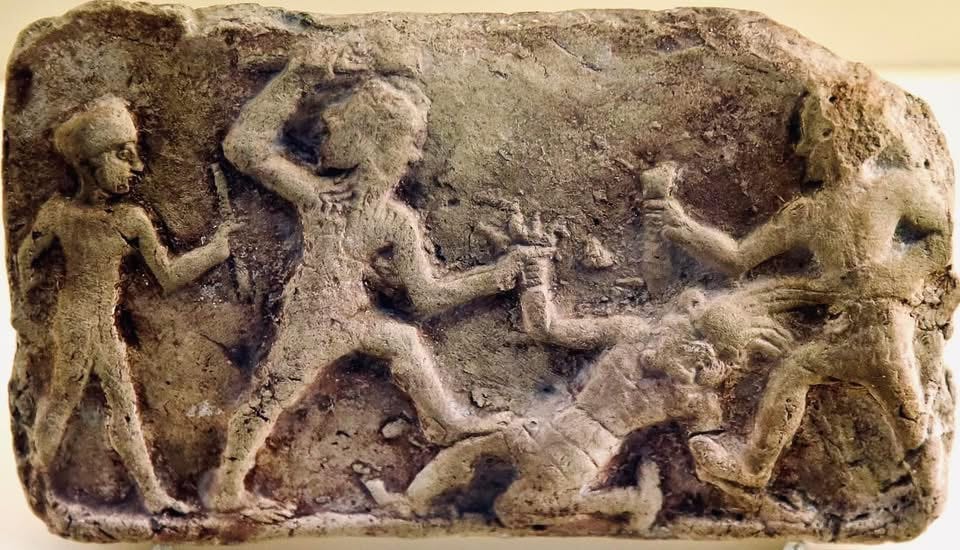
Gilgamesh and Enkidu slay Humbaba (19th - 17th century BCE)
Gilgamesh
A verse play by David Rizzo
Act I, Scene I
Gilgamesh:  (To a pallet with the deceased Enkidu laid out)

My friend, you lie unmoving as in a dream
Quite different, and yet identical
To your most wakeful moments. Time and space
Now watery, now blurred like ink on paper
Mixing with rain.  Dream time is deceptive
It’s there that you confront the other world.


Chorus:      (directly to audience):

Forgive him the archaic manners, please.
A tragic hero is by definition
Well, tragic. Fit for poetry not prose.
So too is Gilgamesh. His second half
Lies rotting there… And he is desolate.
For many days he stayed with Enkidu
But now he sees his friend’s become


Gilgamesh:

Food for worms.


(He takes a lit torch and touches it to Enkidu, igniting the pallet in orange                                   flames. He performs a dance of uncontrollable grief. The stage goes dark                         as the scene ends)
Fabulous !!!! you must complete to the end … I will stay tuned if you need feedback now and then …
I am a fanatic of ancient tales …. in my case Greek mythology .. I wrote three plays - an revised Oedipus (as I see him), a Medea (the first feminist ever) and I even invented a play for Ismene (Oedipus’ younger daughter) … the first two are on my early posts.
but Gilgamesh is terrific …. looking forward to it .
I’d love to read more of this, David!